

Why “Flashcards Alone” Aren’t the Problem
Search terms like “Anki alternatives” or “better flashcard apps” have surged in recent years — not because flashcards stopped working, but because many students feel overwhelmed by the way they’re forced to use them.
For a lot of learners, Anki represents both promise and frustration.
On one hand, it’s backed by strong learning science and widely recommended in high-performance academic circles. On the other, many students struggle with:
- A steep learning curve before seeing results
- Managing hundreds (or thousands) of cards
- Keeping flashcards in sync with class notes and lectures
In practice, flashcards often live separately from where learning actually begins. Learning actually begins through notes, slides, PDFs, and lectures. Students are expected to manually translate raw material into recall prompts, often across multiple platforms.
Even newer AI-powered flashcard alternatives don’t fully solve this. While they reduce manual card creation, they still require students to:
- Upload notes or PDFs after the fact
- Switch to a separate platform just to study
- Manage yet another tool in an already fragmented workflow
The result isn’t better learning—it’s more friction.
The core issue isn’t Anki, or flashcards in general. It’s fragmented study workflows.
Learning tends to work best when capture (notes), understanding, recall, and review happen inside a single, cohesive system — not across disconnected tools stitched together by willpower alone.
What Anki Does Well (And Why Students Still Use It)
Before comparing systems, it’s important to be clear: Anki works—when used correctly. Its long-standing popularity isn’t accidental, and dismissing it outright would ignore decades of cognitive science.
The Strengths of Anki
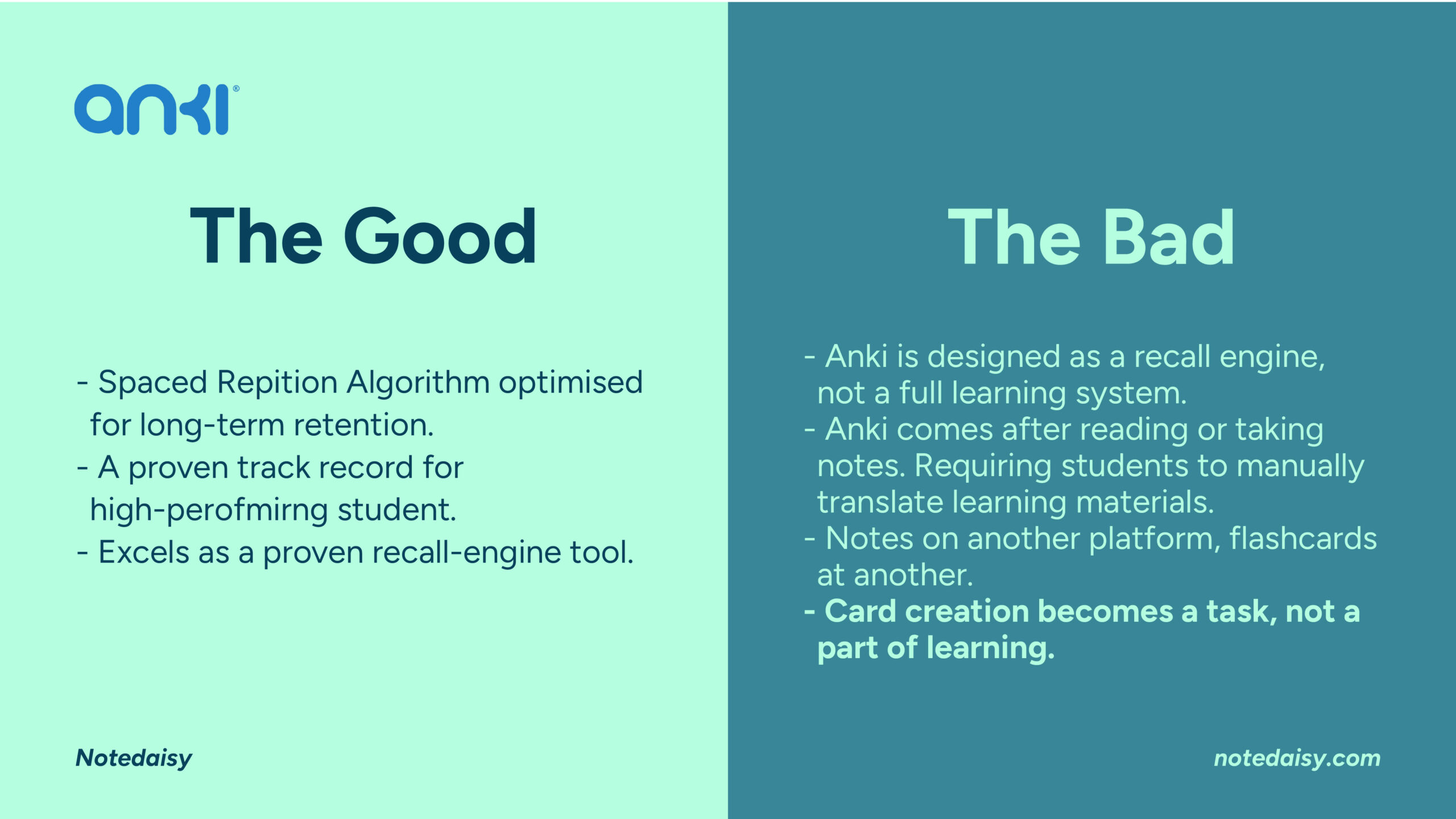
Anki’s biggest strength lies in its spaced repetition algorithm, which schedules reviews at increasing intervals to optimize long-term memory retention. This approach is well-supported by research on forgetting curves and retrieval practice.
Beyond that, Anki offers:
- Deep customisation for card types, scheduling, and add-ons
- Fine-grained control for advanced users
- A proven track record among high-performing students
When flashcards are well-designed and consistently reviewed, Anki can be extremely effective—especially for memorisation-heavy content.
Where Anki Fits Best
Anki tends to work best for learners who:
- Are studying content that prioritises recall over synthesis
- Don’t mind investing time upfront to configure their system
- Already have a separate, organised note-taking workflow
This is why Anki is especially popular in contexts like:
- Medical and dental school
- Language learning
- Standardised exams with large volumes of discrete facts
For these use cases, Anki excels as a recall engine.
The challenge arises when students try to make Anki do more than it was designed for—such as serving as a complete note-taking and learning system.
Where Anki Starts to Break Down for Most Students
Anki is powerful, but power comes with tradeoffs. For many students outside of highly structured, memorisation-heavy programs, those tradeoffs begin to outweigh the benefits.
This isn’t because students are “using Anki wrong.” It’s because Anki was designed as a recall engine, not a full learning system.
The Note-to-Flashcard Gap
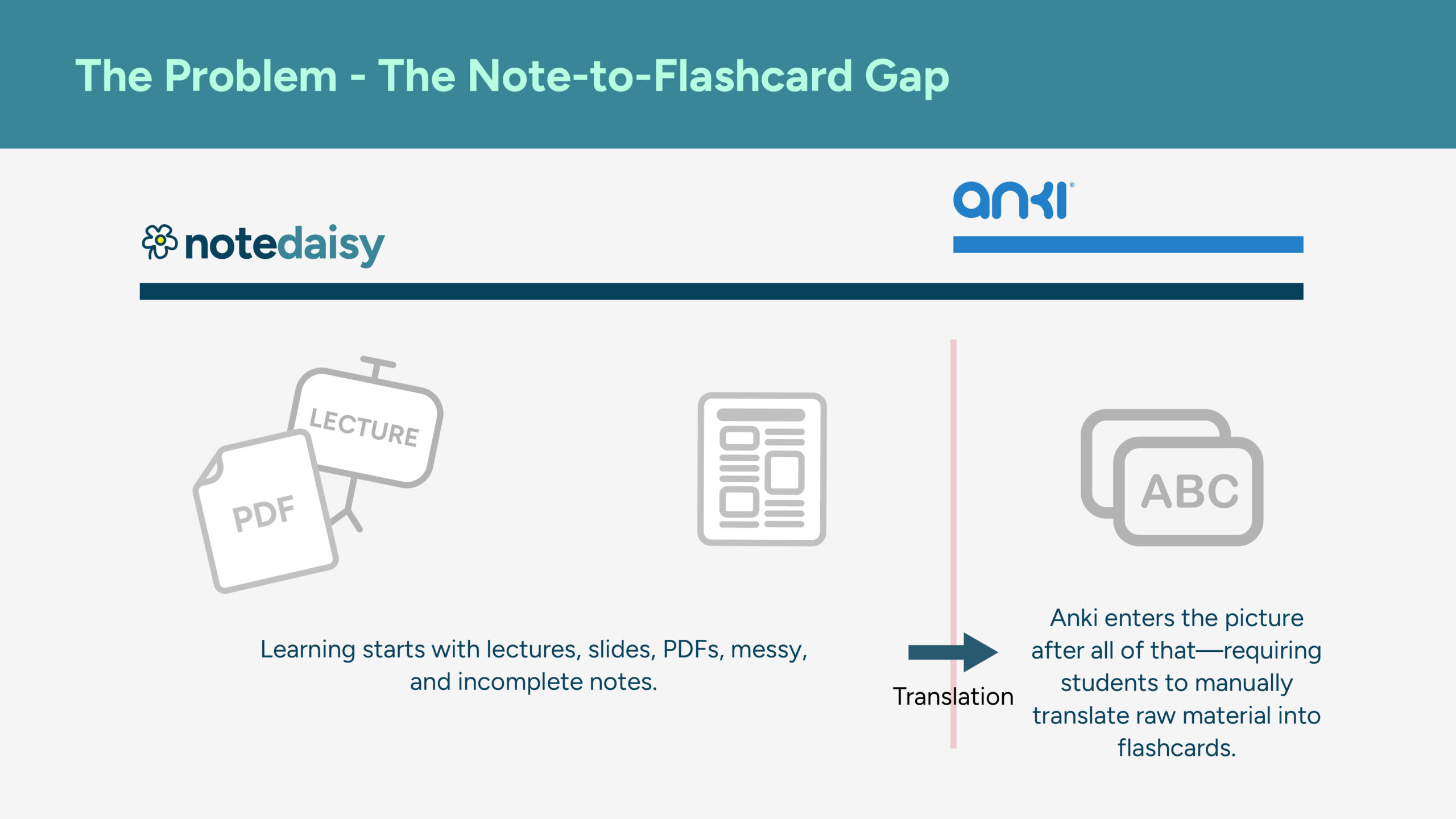
In most real study scenarios, learning starts with:
- Lectures
- Slides
- PDFs
- Messy, incomplete notes
Anki enters the picture after all of that—requiring students to manually translate raw material into flashcards.
This creates several problems:
- Notes live in one app, flashcards in another
- Card creation becomes a separate task, not part of learning
- Context from the lecture or explanation is often lost
Over time, this gap adds friction. Students either delay card creation, rush it, or skip it altogether—breaking the connection between understanding and recall.
Cognitive Overload and Card Explosion
Anki encourages completeness. Students often respond by creating too many cards “just in case.”
The result:
- Hundreds of low-quality or redundant cards
- Difficulty identifying what actually matters for exams
- Review sessions that feel endless and demoralizing
Instead of reinforcing learning, reviews become a grind. Research on cognitive load shows that overwhelming learners with excessive or poorly prioritised material can actively impair retention and motivation.
This is why many students report burning out on Anki — not because recall doesn’t work, but because the system doesn’t help them decide what’s worth recalling.
Not Built for Understanding-First Learning
Anki shines once understanding already exists. It struggles earlier in the learning process.
Specifically, it offers limited support for:
- Concept building and relationships between ideas
- Structured note-taking (e.g., Cornell notes, outlines)
- Exam-oriented preparation that goes beyond fact recall
For courses that emphasize reasoning, application, or synthesis, students are often forced to rely on separate tools for understanding — then jump into Anki later for memorization.
That split can work, but it increases cognitive overhead and makes consistency harder to maintain across an entire semester.
What Students Actually Need: A Note-Taking System, Not Just Flashcards
Most students don’t fail because they avoid flashcards. They struggle because their study tools don’t reflect how learning actually happens.
Effective studying isn’t a single action — it’s a process. And tools that only support one stage of that process often leave students stitching everything else together themselves.
At a high level, successful learning tends to follow a simple loop:
Capture → Understand → Recall → Review
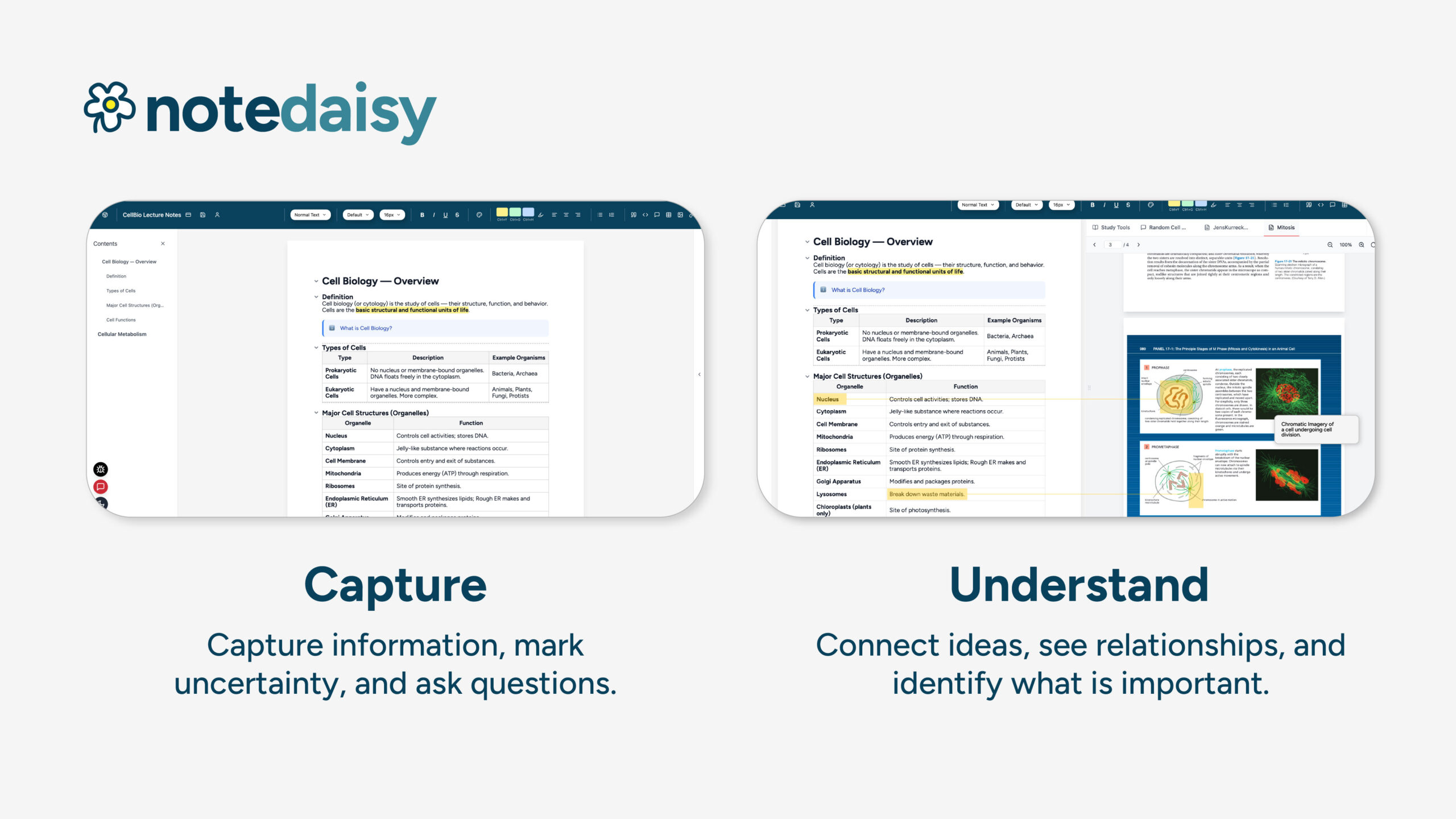
Capture: Where Learning Begins
Learning starts in imperfect conditions:
- Fast-paced lectures
- Dense slides
- Partially understood explanations
At this stage, students need a flexible space to capture information, ask questions, and mark uncertainty — not worry about turning everything into a polished recall prompt.
Understand: Making Sense of the Material
Before recall is effective, students need to:
- Connect ideas
- See relationships between concepts
- Identify what’s important versus what’s peripheral
This is where structured note-taking, summarisation, and rephrasing play a critical role. Skipping this step and jumping straight to flashcards often leads to shallow memorisation without comprehension.
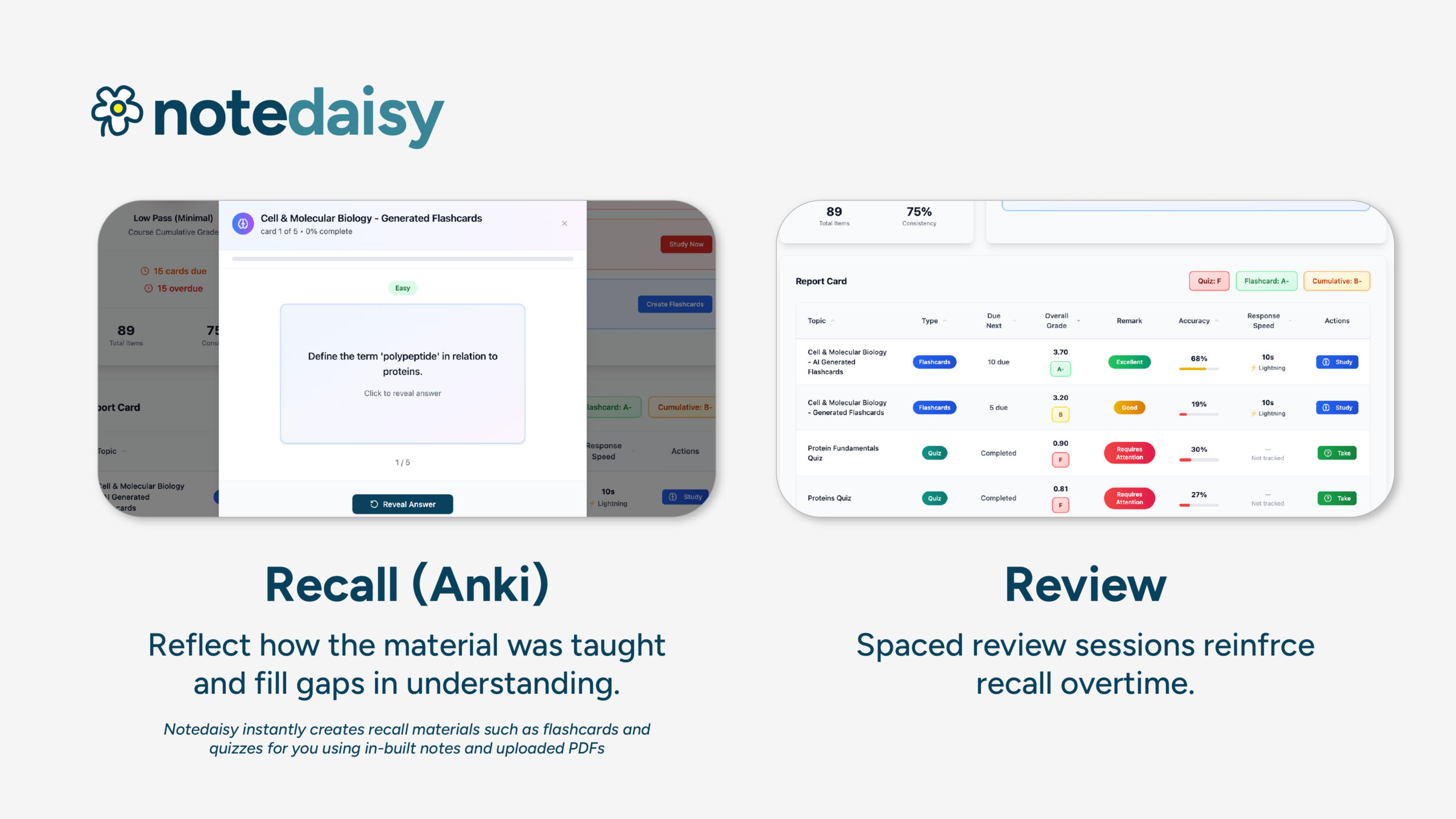
Recall: Testing What Actually Sticks
Active recall is one of the most reliable ways to strengthen memory—but it works best after understanding exists.
When recall is embedded directly into the note-taking process:
- Questions are grounded in real context
- Prompts reflect how material was taught
- Gaps in understanding surface earlier
When recall is bolted on later, it’s easier to miss nuance and overemphasive trivia.
Review: Making Learning Last
Spaced review reinforces learning over time. But it only works when:
- Material is easy to revisit
- Review doesn’t require switching tools
- Progress feels manageable
When notes, recall prompts, and review live in different places, consistency becomes the first casualty.
The Core Problem With Flashcards-Only Tools
Flashcards are powerful. But on their own, they represent just one phase of the learning cycle.
Students don’t need “better flashcards.”
They need systems that connect notes to recall without friction.
This shift from tools to systems is what separates short-term memorisation from long-term learning and exam performance.
How Notedaisy Approaches Active Recall Differently
If flashcards work best when they’re part of a larger learning system, the question becomes: what does that system actually look like in practice?
Notedaisy was designed around a simple idea—recall should emerge from your notes, not replace them. Instead of treating flashcards as a separate destination, Notedaisy integrates recall directly into the note-taking workflow.

Notes and Recall in One Place
In Notedaisy, notes act as the source of truth.
As students take notes—whether from lectures, PDFs, or readings—they can:
- View flashcards alongside their notes
- Create recall prompts while concepts are still fresh
- Generate flashcards and quizzes directly from notes or PDFs
This reduces context switching and removes the “I’ll make flashcards later” problem that often leads to skipped or rushed recall.
Instead of translating notes into another system, recall becomes part of the learning process itself.
Flexible Recall Formats (Not Just Cards)
While traditional flashcards are effective for memorisation, real exams often require more than one-word answers.
Notedaisy supports multiple recall formats, including:
- Flashcards for direct retrieval
- Quizzes (multiple choice, identification, short answer)
- Question-based notes that encourage explanation and synthesis
This flexibility helps students practice recalling information in ways that better reflect how they’ll be tested—especially in courses that emphasise understanding, application, or reasoning.
Lower Setup Cost, Faster Feedback Loop
One of the most common barriers to consistent recall is setup time.
Notedaisy reduces this by:
- Eliminating complex deck structures
- Removing the need for plugins or heavy customisation
- Shortening the gap between learning and testing
The result is a faster feedback loop: students learn something, test it, identify gaps, and adjust—all without leaving the same environment.
Rather than optimising for power users, the system is built for everyday students who want active recall to be sustainable across an entire semester.
Notedaisy vs Anki: Side-by-Side Comparison
At this point, the difference between Anki and Notedaisy isn’t about whether flashcards work — it’s about how much of the learning process each tool supports.
The table below highlights where each system excels and what kind of student it’s best suited for.

This comparison isn’t about declaring a “winner.” It’s about fit.
Anki remains one of the most powerful recall tools available—but it assumes students already have a disciplined, separate note-taking and organisation system in place.
Notedaisy, by contrast, is built around the idea that recall should be embedded into how students already study, not added as a second system they have to maintain.
Which One Should You Use?
Both tools can work—but they serve different types of learners and study styles.
Use Anki if:
- You enjoy fine-grained customisation
- You’re memorising large volumes of discrete facts
- You already use a separate, well-structured note-taking system
- You don’t mind investing time in setup and maintenance
Use Notedaisy if:
- You want notes and recall in one place
- You’re studying for exams that test understanding, not just memory
- You prefer low-friction workflows you’ll actually stick with
- You want active recall to happen naturally as you take notes
Final Verdict: Flashcards Are a Tool—Systems Win Exams
Flashcards aren’t the problem.
And Anki isn’t “outdated” or ineffective.
What consistently holds students back is trying to force a single tool to do the job of an entire study system.
Anki excels at one thing: long-term recall. For students who already have structured notes, clear priorities, and the discipline to maintain multiple tools, it remains one of the most powerful recall engines available.
Notedaisy takes a different approach.
Instead of optimising for recall in isolation, it focuses on the full learning loop — from capturing notes, to building understanding, to practicing recall, to reviewing over time. By embedding active recall directly into note-taking, it reduces friction and makes effective studying easier to sustain across an entire semester.
In the end, the “best” tool isn’t the one with the most features or the strongest algorithm.
It’s the one that fits how you actually study—especially when time is tight and motivation is low.
Flashcards help you remember.
Systems help you learn.


