Why Most College Notes Don’t Work
If you’ve ever walked out of a college lecture with pages of notes and still felt completely lost before an exam, you’re not alone. Many of us have been there. I’ve observed people typing furiously during class, highlighting everything later, rereading notes the night before a test… and then realising we can’t actually recall the material when the exam comes.
This was exactly my experience in college. We took “good” notes by every traditional standard: neat outlines, clear headings, detailed explanations. Professors complimented them. Friends borrowed them. But when exams came around, those notes didn’t translate into confidence or strong recall. The problem wasn’t effort — it was that our note-taking methods were optimised for recording information, not learning it.
Cognitive science helps explain why this happens. Research has consistently shown that passive strategies like rereading or copying notes create a false sense of understanding, because recognising information is much easier than retrieving it from memory. In a well-known study by Roediger and Karpicke (2006), students who repeatedly tested themselves remembered significantly more than those who spent the same amount of time rereading the material — even though the rereading group felt more confident while studying.
Most college students are never taught how learning actually works. We’re told to “take good notes,” but rarely shown which note-taking methods are supported by research on memory, retention, and recall. As a result, students default to familiar systems like linear notes or slide transcription, even though studies on learning and memory suggest that retrieval practice and active engagement are far more effective for long-term retention (Dunlosky et al., 2013).
In this guide, we’ll break down the best note-taking method for college students, grounded in cognitive science and informed by real college study experiences. We’ll compare popular systems like the Cornell method, outlining, and active recall, explain where each one works (and where it falls short), and show why the most effective notes aren’t the prettiest — they’re the ones designed to help you remember.
How Learning Actually Works (According to Cognitive Science)
Learning Is Not the Same as Exposure
One of the biggest misunderstandings in college studying is the belief that exposure to information equals learning. Attending lectures, reading slides, and reviewing notes all feel productive — but feeling productive doesn’t guarantee that learning has occurred.
Cognitive psychologists distinguish between recognition and recall. Recognition happens when information looks familiar, such as when you reread notes and think, “Yes, I remember this.” Recall, on the other hand, is the ability to retrieve information from memory without seeing it. Exams overwhelmingly test recall, not recognition — yet most students spend the majority of their study time reinforcing recognition.
This mismatch is why many students feel confident while studying but struggle during exams, a phenomenon researchers often describe as the illusion of competence.
How Memory Works: Encoding, Storage, and Retrieval
From a cognitive science perspective, learning involves three key stages:
- Encoding – processing new information
- Storage – maintaining that information over time
- Retrieval – accessing it when needed
Most note-taking advice focuses heavily on encoding — capturing information accurately during lectures. While encoding matters, research consistently shows that retrieval is the most critical stage for long-term learning. If information cannot be retrieved, it might as well not exist.
In college, retrieval is where most breakdowns occur. Students often encode information multiple times (listening, writing, rereading) but rarely practice pulling it out of memory. As a result, knowledge remains fragile and context-dependent, surfacing only when the notes are visible.

Why Passive Note-Taking Feels Effective (But Isn’t)
Passive strategies like rereading notes, highlighting text, or copying slides persist because they create a sense of fluency. The material feels smoother and easier to process each time it’s seen, which students interpret as learning.
However, fluency is misleading. A [comprehensive review](https://pubmed.ncbi.nlm.nih.gov/26173288/](https://pubmed.ncbi.nlm.nih.gov/26173288/?utm_source=chatgpt.com)) of ten popular learning strategies found that techniques such as rereading and highlighting show low effectiveness for long-term retention, despite being among the most commonly used by students
This explains a familiar college experience: notes that feel clear and understandable during review suddenly seem inaccessible during an exam. The notes supported recognition, but the exam demanded retrieval.
The Role of Retrieval in Long-Term Learning
Retrieval practice (actively recalling information from memory) changes how learning works. Each attempt to retrieve information strengthens the underlying memory trace, making future retrieval more reliable and faster.
In a landmark study on the [testing effect](https://www.structural-learning.com/post/testing-effect-retrieval-practice](https://www.structural-learning.com/post/testing-effect-retrieval-practice?utm_source=chatgpt.com), students who repeatedly tested themselves remembered significantly more information after a delay than students who spent the same amount of time rereading the material.
Importantly, retrieval doesn’t require formal exams or quizzes. Self-testing, practice questions, and recall-based note review all engage the same cognitive mechanisms. Even unsuccessful retrieval attempts — when you struggle and partially fail — can enhance learning more than passive review.
What This Means for Note-Taking
From a cognitive science perspective, the purpose of notes is not to store information, but to support retrieval later. Notes that are never used to test understanding contribute little to long-term learning, no matter how detailed or organised they are.
Effective note-taking methods therefore share one key feature: they make it easy to practice recall. This can mean turning headings into questions, summarising information from memory, or structuring notes so that reviewing them requires active engagement rather than rereading.
In the next sections, we’ll apply these principles to popular note-taking systems — including the Cornell method, outlining, and active recall — and evaluate how well each one aligns with what cognitive science tells us about how students actually learn.

What Makes a “Good” Note-Taking Method?
Why Most Students Choose the Wrong Criteria
When college students talk about “good” notes, they usually mean notes that are neat, detailed, and complete. If the notes look organized, cover everything from the lecture, and can be easily reread later, they’re considered successful.
We used to judge our notes the same way. If a page looked clean and thorough, we felt productive leaving class. But over time, a pattern emerged: the notes that looked the best were often the ones we relied on the least during exam preparation — because rereading them didn’t actually help us recall the material.
Cognitive science explains why this happens. Visual organisation and completeness make information feel fluent and familiar, which feeds the illusion of competence. Unfortunately, these surface-level qualities say very little about whether a note-taking method actually supports long-term learning
A Better Way to Evaluate Note-Taking Methods
If the goal of note-taking is learning — not just recording — then note-taking methods should be evaluated based on how well they support the learning process. Based on research in cognitive psychology, effective note-taking methods tend to share several key characteristics.
A good note-taking method should:
1. Encourage retrieval, not just review
The method should make it easy to test your understanding from memory, not just reread information. Retrieval practice is one of the most robust [findings in learning science](https://www.structural-learning.com/post/testing-effect-retrieval-practice](https://www.structural-learning.com/post/testing-effect-retrieval-practice)
2. Force active processing during or after class
Effective notes require you to rephrase, summarise, question, or reorganise information — all of which strengthen encoding and understanding.
3. Scale across courses and time
A method should work for dense STEM lectures, reading-heavy humanities courses, and cumulative finals — not just one ideal scenario.
4. Support efficient review before exams
Reviewing notes should involve doing something (recalling, answering questions), not passively scanning pages.
These criteria shift the focus from how notes look to how notes are used.
Capturing Information vs Learning It
One of the most important distinctions students rarely make is between capturing information and learning it.
During lectures, your primary job is to capture key ideas accurately and efficiently. During study sessions, your job is to turn that captured information into something you can retrieve under pressure.
Problems arise when a note-taking method is expected to do both jobs at once. Methods that excel at capturing information (like outlining or slide transcription) often fail at supporting learning, because they stop at storage. Learning requires an additional step — transformation and retrieval.
Recognising this distinction is crucial, because it explains why no single format magically produces learning on its own.
The Reality of Typed Notes in College
While much research compares handwritten and digital notes, the reality for most college students is simple: they type. Laptops are faster, searchable, and often necessary for accessibility or speed.
Research suggests that handwriting can encourage deeper processing under certain conditions, but those benefits disappear when students transcribe verbatim — something that happens frequently with laptops and notebooks
This means the most practical question isn’t handwritten vs digital, but whether a note-taking method — typed or not — forces meaningful engagement and retrieval. Any method that relies solely on the medium, rather than the process, is fragile.
Setting the Stage for Comparing Note-Taking Methods
With these criteria in mind, we can now evaluate popular note-taking systems more clearly. The question is no longer which method looks the most organized, but which one aligns best with how memory actually works.
In the next sections, we’ll break down three widely used approaches — the Cornell method, outlining, and active recall-based note-taking — and assess how each performs when measured against cognitive science, not aesthetics.

Comparing the Most Popular Note-Taking Methods
When college students look for the “best” note-taking method, they usually encounter the same three approaches: the Cornell method, outlining, and some version of active recall-based notes. Each method is popular for a reason — but popularity doesn’t always align with how learning actually works.
Using the cognitive science criteria from the previous section, we can now evaluate how each method performs in practice.
The Cornell Note-Taking Method
The Cornell method divides a page into three sections: a main notes area, a cue column for questions or keywords, and a summary section at the bottom. In theory, this structure encourages students to review actively by covering the main notes and testing themselves using the cue column.
Where Cornell works well:
The Cornell method introduces the idea of retrieval. When used correctly, writing questions in the cue column and answering them later can support active recall and spaced review.
Where it often breaks down:
In real college settings, many students never return to fill in the cue column or summary. The method becomes a structured form of passive notes — neatly organized, but rarely tested. Without consistent retrieval practice, the cognitive benefits largely disappear.
Cornell also struggles with dense, fast-paced lectures, where students default to transcribing content just to keep up.
The Outlining Method
Outlining is one of the most common note-taking methods among college students, especially for typed notes. Information is arranged hierarchically using headings, bullet points, and indentation.
Where outlining works well:
Outlines are fast. They’re easy to maintain during lectures and map cleanly onto slide-based teaching. For capturing large volumes of information, outlining is efficient and flexible.
Where it falls short:
The outlining method primarily supports storage, not learning. Because it emphasizes organization over processing, students often type information verbatim. Research shows that verbatim note-taking — regardless of medium — leads to weaker understanding and retention
Outlines also encourage rereading during exam prep, which feels productive but creates an illusion of competence rather than durable learning.
Active Recall-Based Note-Taking
Active recall-based note-taking flips the traditional approach. Instead of storing information in complete form, notes are structured around questions, prompts, and incomplete cues that force retrieval during review.
This can look like:
- Question-first notes
- Concept prompts instead of explanations
- Notes designed to be tested, not reread
Where active recall excels:
Retrieval practice is one of the most well-supported learning strategies in cognitive science. Actively recalling information strengthens memory far more than passive review.
Active recall-based notes also scale well for cumulative exams, because they naturally support spaced repetition and self-testing.
The tradeoff:
This approach requires more effort upfront. Notes may look incomplete or messy, which can feel uncomfortable — especially to students used to polished pages. However, that discomfort is often a signal that real learning is happening.
| Note-Taking Method | How It Works | Strengths | Limitations | Alignment With Cognitive Science | Best Use Case |
|---|---|---|---|---|---|
| Outlining Method | Information is organized hierarchically using headings, bullet points, and indentation | Fast to use during lectures; easy to organize large volumes of content; works well with slides | Encourages verbatim transcription; relies heavily on passive rereading; weak support for recall | Low — prioritizes storage over retrieval and deep processing | Capturing information quickly during fast-paced lectures |
| Cornell Method | Notes are divided into main notes, cue/questions column, and a summary section | Built-in structure; introduces prompts for review; can support retrieval if used properly | Cue and summary sections often left unused; becomes passive without follow-up; time-consuming in dense lectures | Moderate — effective only when cue-based retrieval is consistently applied | Students who want structure and are disciplined about reviewing |
| Active Recall-Based Notes | Notes are built around questions, prompts, and incomplete cues designed for self-testing | Strongly supports retrieval practice; improves long-term retention; efficient exam review; scales well over time | Higher effort upfront; notes may feel incomplete or “messy” | High — closely aligned with evidence-based learning research | Learning and retaining material for exams and cumulative courses |
The Verdict: Retrieval Beats Recording
After comparing outlining, Cornell, and active recall-based notes, one fact is clear: the method that most closely aligns with how memory works wins. While structured systems like Cornell or simple outlining can help organize and capture information, they only produce long-term learning when paired with active retrieval.
The best approach for college students is a hybrid workflow:
- Capture efficiently — use outlining or Cornell to quickly record key information during lectures.
- Transform for learning — convert those notes into prompts, questions, or summaries that force recall.
- Review deliberately — practice recalling answers from memory instead of rereading notes.
This combination ensures that notes serve as a tool for learning, not just storage.
Implementing Active Recall with Typed Notes
For students who type notes, active recall can be seamlessly integrated:
1. Convert headings into questions
Instead of keeping a heading like “Photosynthesis”, write: “What are the steps of photosynthesis?”
2. Turn bullet points into prompts
Each subpoint becomes a mini-question to test yourself. For example:
- Original: “Chlorophyll absorbs light energy”
- Recall prompt: “Which pigment absorbs light energy in photosynthesis?”
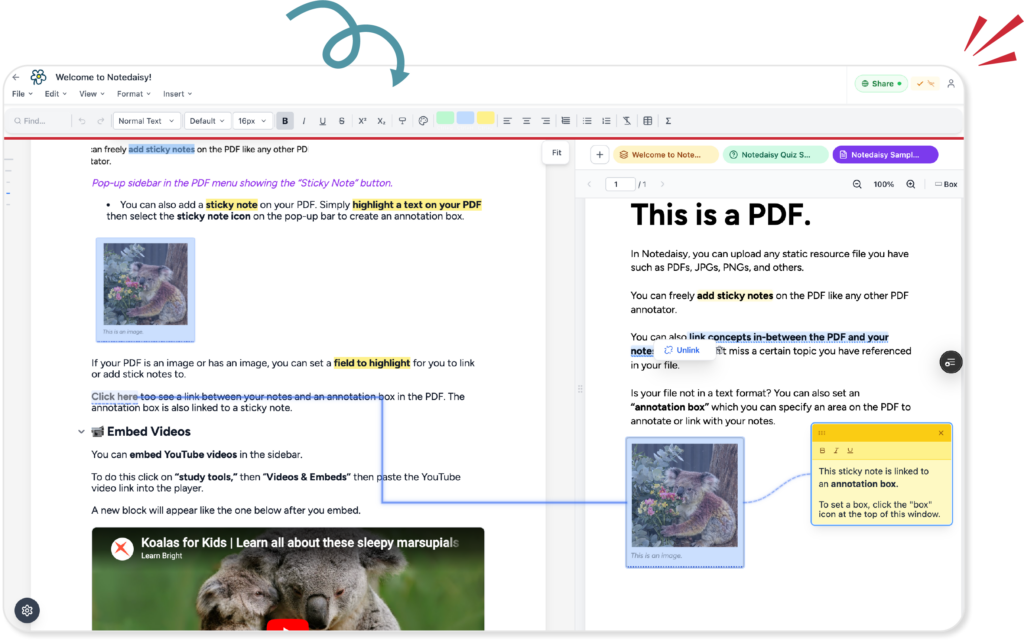
Notedaisy has a “callout” option which visually distinguished text as prompts which can be used for studying later.
3. Use self-testing, not rereading
Cover the answers and attempt to recall them from memory. Struggling is good — it strengthens retention.
4. Avoid common mistakes
- Copying slides verbatim → passive learning
- Leaving cue columns empty → no retrieval
- Reviewing all notes in one session → inefficient
5. Schedule spaced review sessions
- Review prompts multiple times over days/weeks
- Gradually increase intervals to enhance long-term retention
By following this workflow, students transform their typed notes into a dynamic, recall-focused learning system, giving them the best chance to succeed on exams — without spending endless hours rereading.
Common Note-Taking Myths
College students often fall for several widespread myths about note-taking:
Myth 1: More notes = better grades
Many students believe that writing everything in the lecture guarantees success. In reality, quantity rarely equals quality. Cognitive science shows that without active processing, even the most detailed notes contribute little to retention
Myth 2: Handwritten notes are always superior
While handwriting can enhance processing under certain conditions, typed notes are perfectly effective — provided they’re structured for active recall. Typing allows for faster capture, searchability, and digital review, which are essential for most modern students.
Myth 3: Flashcards are the only way to practice active recall
Flashcards are one tool, but any method that forces you to retrieve information works. Turning headings into questions, writing prompts in the margin, or using self-testing within your notes can be just as effective.
By dispelling these myths, students can focus on what truly drives learning: retrieval, processing, and review.
A Smarter Note-Taking Workflow
The most effective note-taking system balances capture with active recall. A practical workflow looks like this:
1. Capture – Record key information quickly during lectures using a structured system (Cornell, outlines, or digital notes).
2. Process – Transform your notes into prompts, questions, or summaries designed for self-testing.
3. Recall – Regularly attempt to retrieve the information from memory instead of rereading.
4. Review – Space review sessions over days or weeks to strengthen long-term retention.
Typed notes don’t have to be static. Platforms designed around active recall — for example, systems like Notedaisy — enable students to turn their typed notes into prompts, quizzes, or interactive summaries that naturally support retrieval. Importantly, this is a contextual example of how technology can facilitate cognitive science-backed note-taking, not a prescriptive requirement.
Final Takeaways
- Active engagement beats aesthetics – Well-organized notes are nice, but notes must challenge your recall to be effective.
- Quality > quantity – Focus on transforming information, not just capturing it.
- Consistency is key – Retrieval works best when practiced regularly, not crammed the night before.
- Adapt to your workflow – Whether handwritten, typed, or digital, the method should support learning, not just storage.
- Leverage smart tools – Use platforms or systems that integrate recall-based workflows to make studying more efficient, scalable, and personalized.
By combining evidence-based principles with smart workflows, students can turn note-taking from a passive task into a powerful learning strategy — improving grades, understanding, and long-term retention.