See how students learn between their notes and AI.

Notedaisy is a document-style course workspace where students collect materials, build their own notes and use AI to question and practise that work. In an opt-in course study, teaching teams receive agreed aggregate learning-process evidence without access to individual private notes.

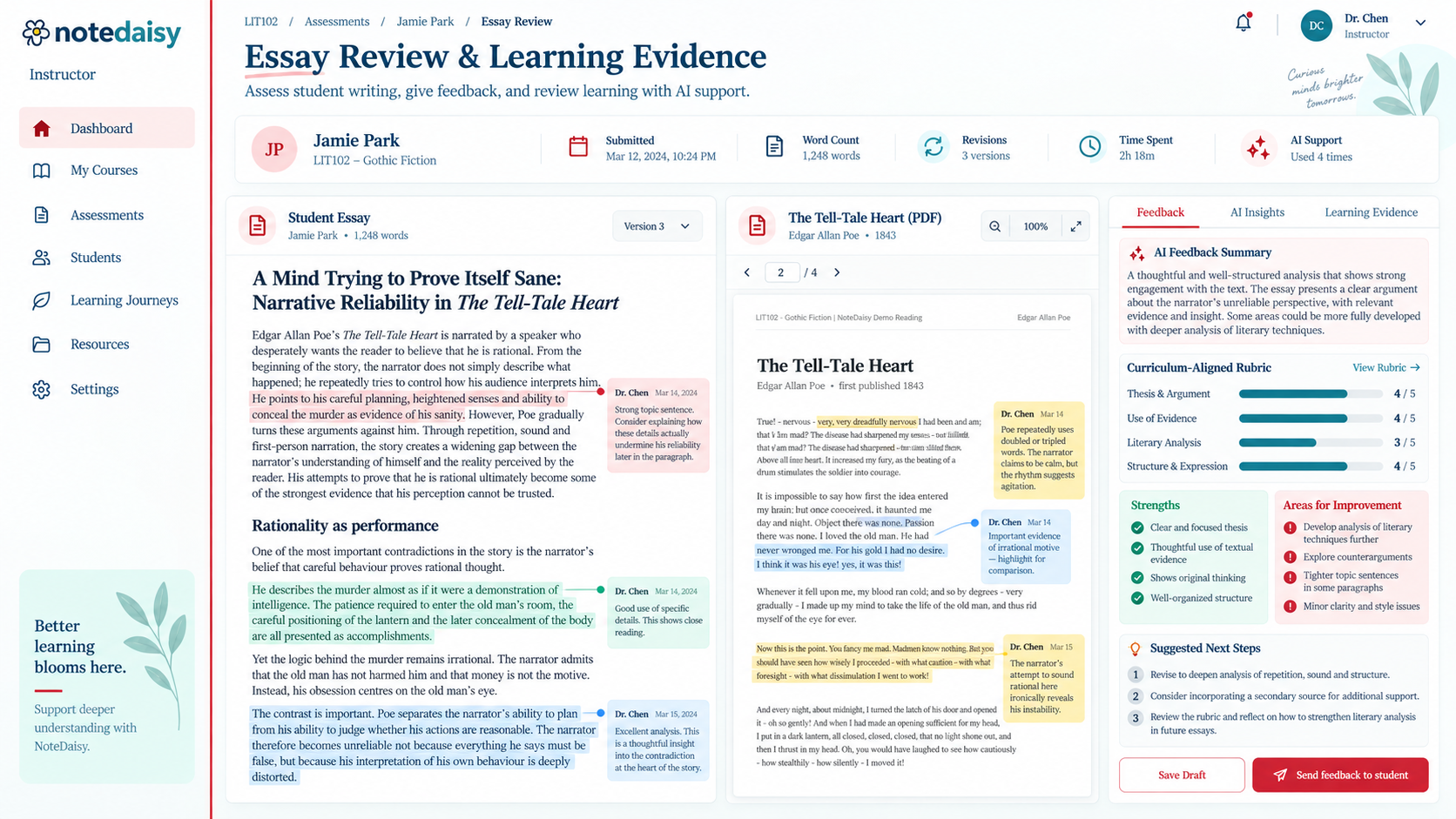
Instead of seeing only the final submission, instructors can see evidence from the learning journey — from the materials a student engaged with and the notes they created to AI assistance, practice activity, revisions and assessment.

Design a 6–8 week pilot
- 6–8 week pilot
- 2–4 courses
- 150–500 opt-in students

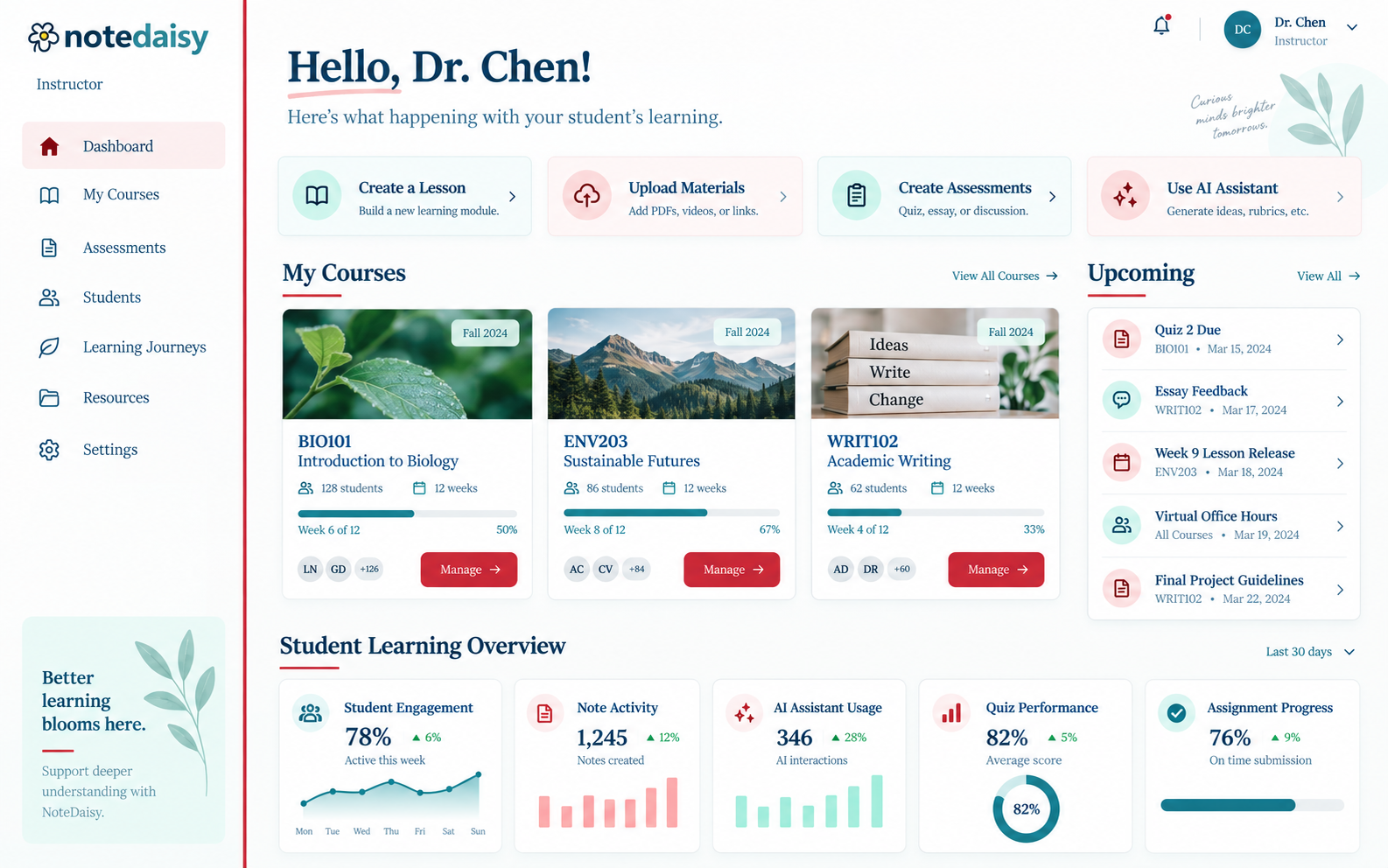
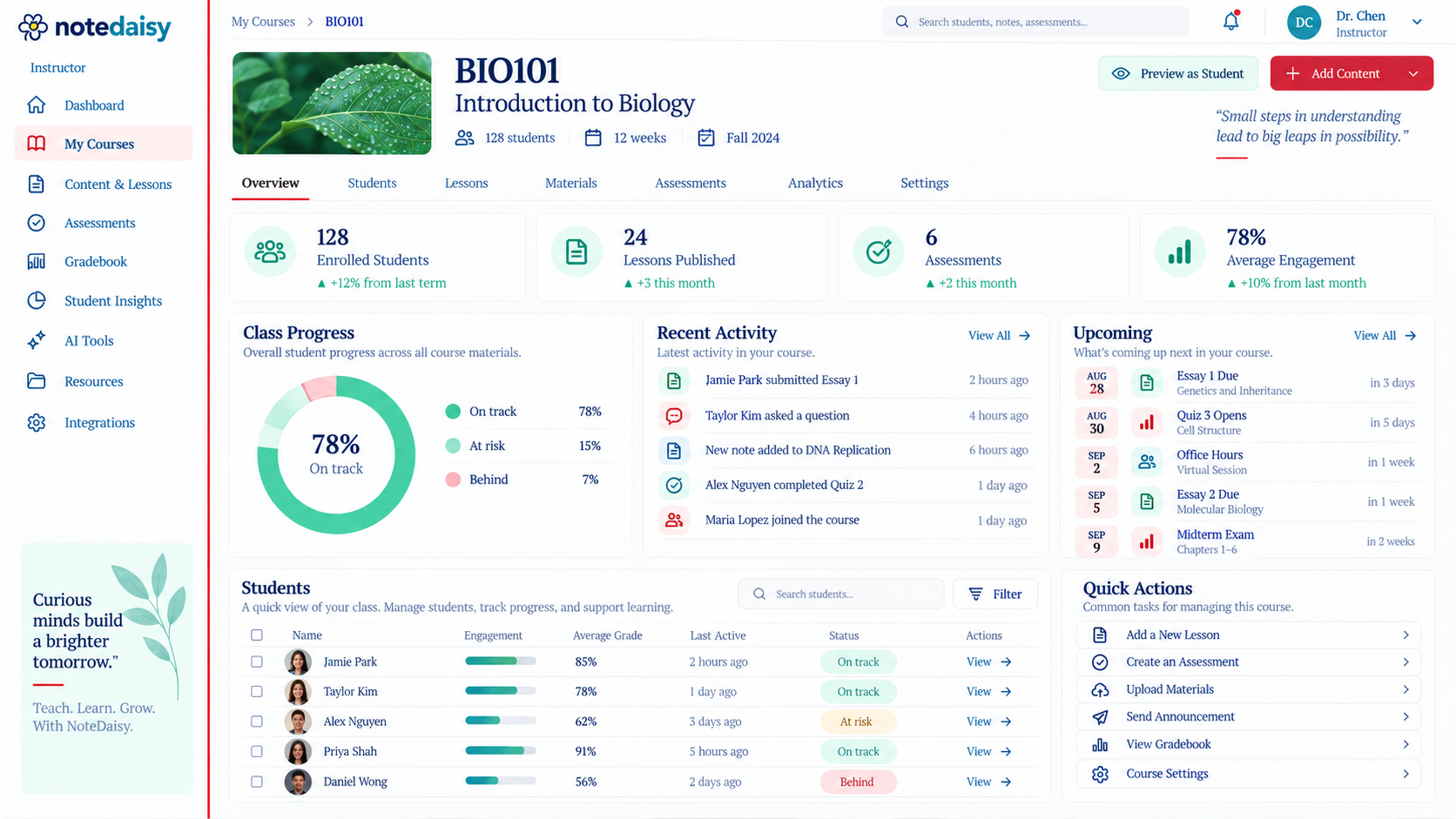
Main dashboard for a course by an instructor who is using Notedaisy LMS

What does responsible artificial intelligence in higher education look like?

Responsible AI in higher education uses artificial intelligence to extend learning while people retain authorship, judgement and human oversight.

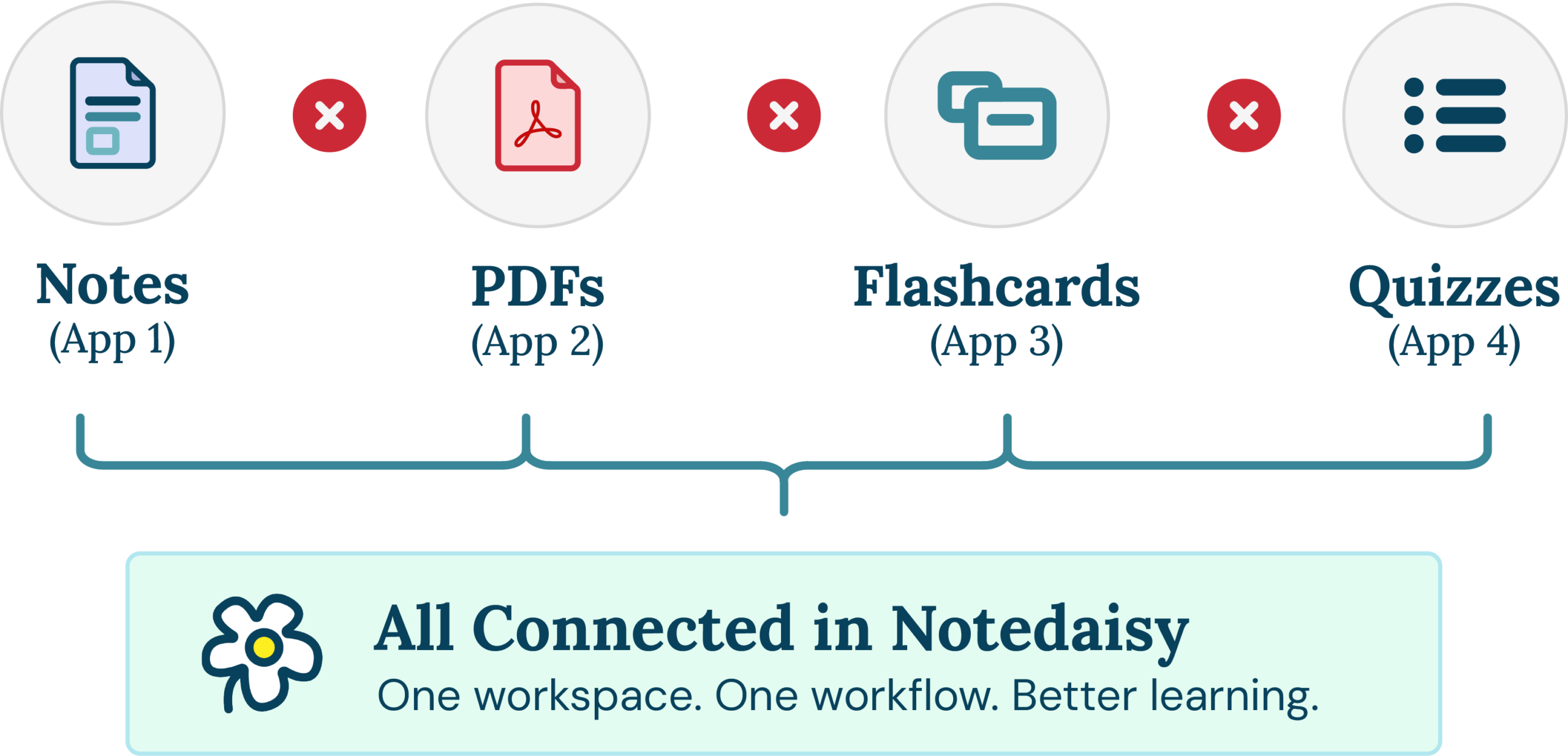
Students commonly leave the LMS for Google Docs, Word, scattered notes and general-purpose AI. That fragments the learning process and leaves educators with little evidence about how students read, organise, revisit and question course material.

Notedaisy partners with universities to embed active-recall AI into teaching and the curriculum, with student-authored notes as the starting point.

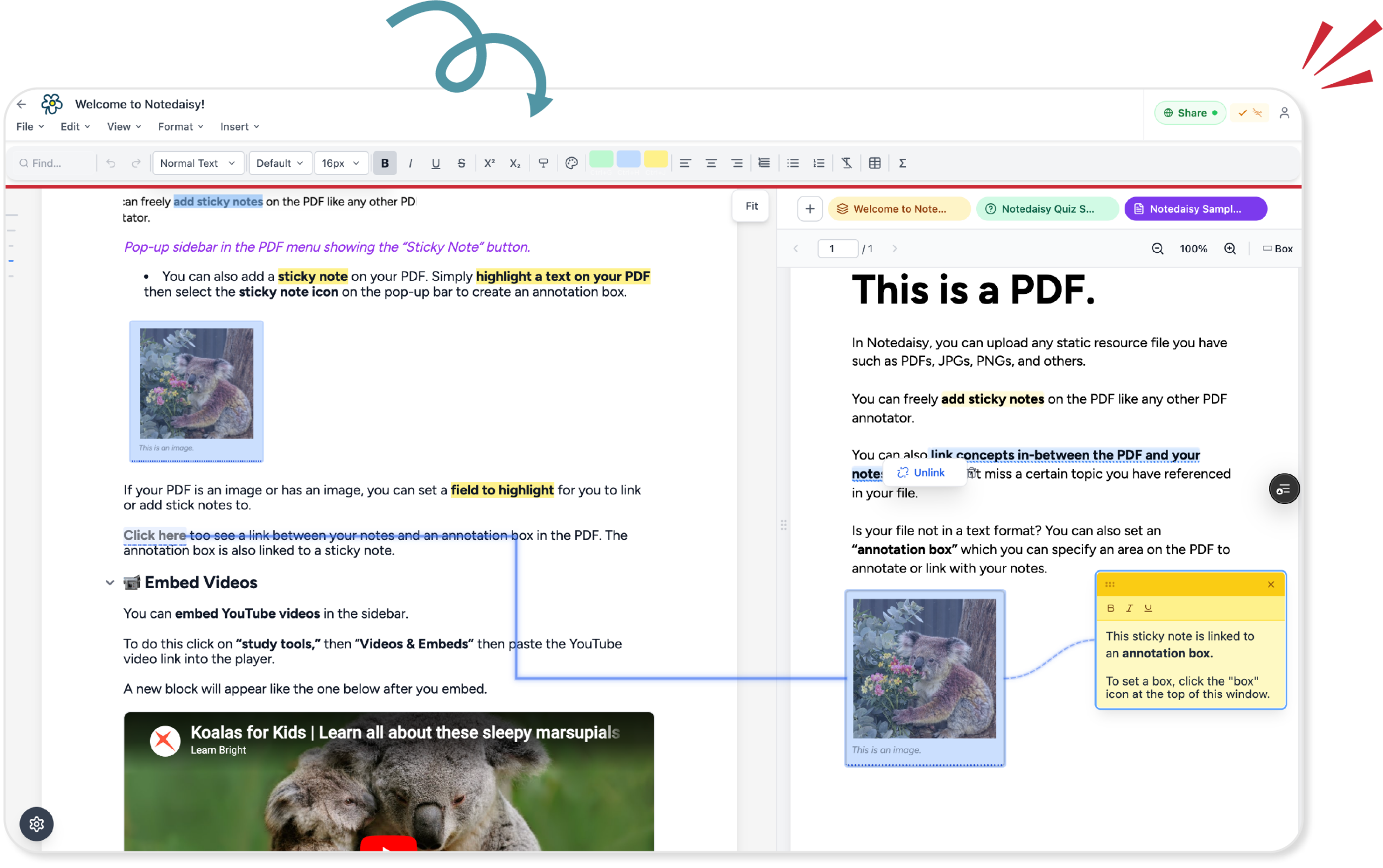
Notedaisy Note Editor

Where Notedaisy Excels at: a Rich Text-Editor and Notes-to-Resource Interaction.

We are not just another AI wrapper, Gemini Notebook, Anki, StudyFetch, nor Remnote.

Our core philosophy centres around note-taking & document-writing.

A rich text-editor akin to Google Docs is at the centre of our product. Note-taking is a vital part of the student's learning experience; and we're putting a lot of attention into it.

This expands our offering from being just a student's own personalised database. Educators can analyse student's behaviour and AI interactions in things like note-taking, report-making, essay-writing, and others.

How AI tools can transform teaching and learning—without bypassing either

The impact of AI depends on where it enters the learning process. Notedaisy places AI after students engage with course materials, helping AI enhance learning rather than replace the work required to understand it.

The approach follows four stages.

1. Capture

Students work with lecture PDFs, readings and course materials while creating and organising their own notes. Their learning begins with the source and their interpretation of it.

2. Understand

Students connect and explain ideas before using AI assistance. They can then use AI to clarify concepts, explore relationships and extend work they have already started.

3. Recall

Notedaisy helps students turn their materials into flashcards, quizzes and active-recall prompts. These AI capabilities help students practise retrieving information instead of repeatedly rereading it.

4. Review

Students return to one organised workspace for repeated practice, tailored feedback and stronger study habits. This creates learning environments in which AI supports an ongoing learning loop rather than a one-off generated answer.

Practical use of AI tools across the learning journey

Generative AI tools are already part of many areas of higher education. The opportunity is to embed AI literacy, clear boundaries and academic integrity into a real study workflow—not treat technology adoption as the outcome.

notedaisy LMS main dashboard for educators

Personalised learning from students’ own materials

AI-driven recall can help students practise the concepts they have captured from their lectures, readings and notes.

Whether your institution uses the term personalised learning or personalized learning, the principle remains the same: the learner’s course context should be the foundation.

The use of AI can support:
- Flashcards and quizzes based on course materials
- Active-recall questions
- Personalized and adaptive learning activities
- Tailored feedback during revision
- Students with reading or recall difficulties
- Students with diverse learning needs
- More organised learning experiences

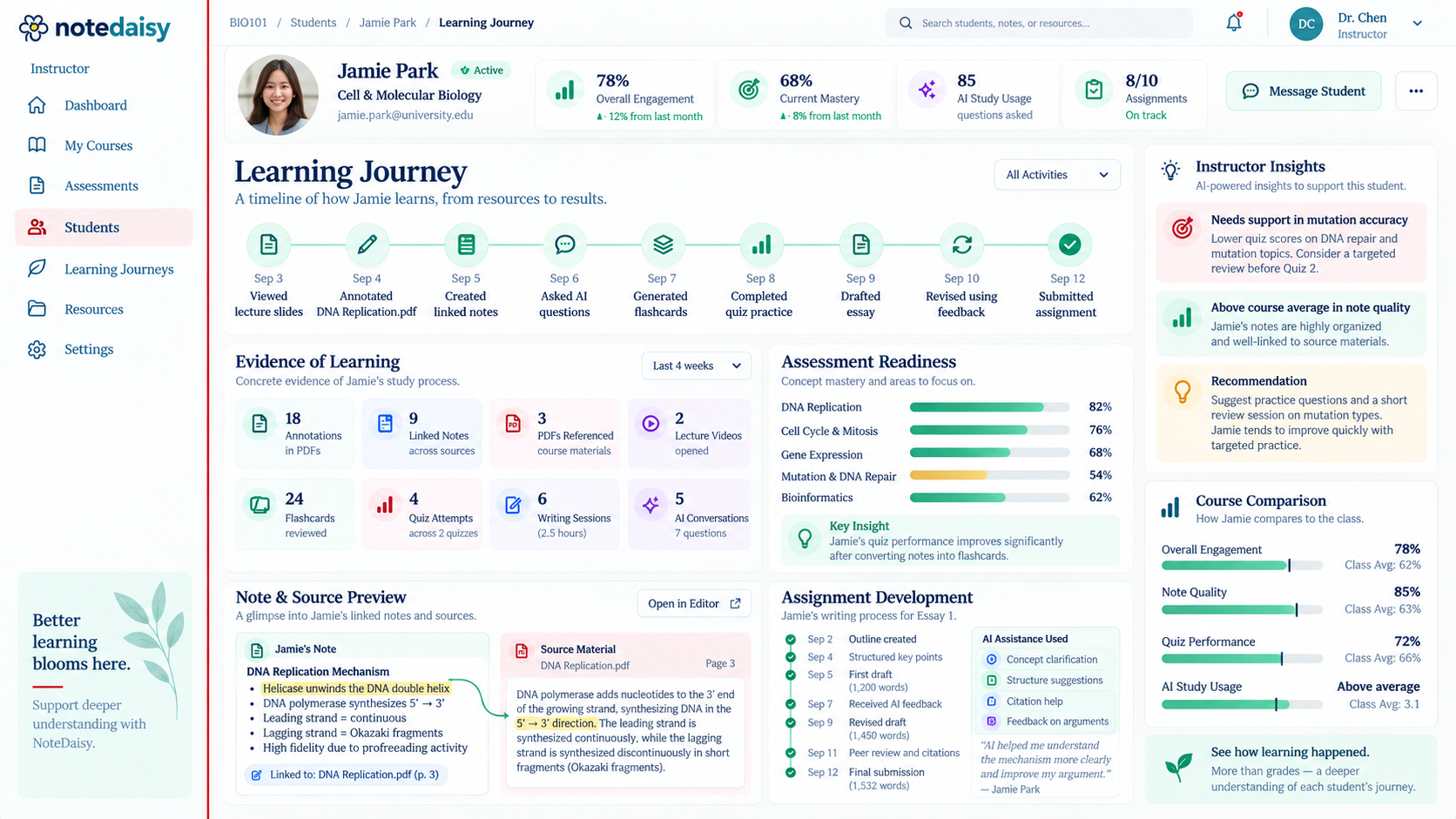
student learning journey dashboard in notedaisy LMS

Help students use AI ethically

Course teams can frame acceptable AI use, discuss plagiarism and show where AI challenges traditional academic practice.

This makes digital and AI literacy, AI skills and academic integrity part of teaching and learning rather than an afterthought.

Students and faculty can develop a shared understanding of:
- When students may use AI
- When AI assistance should be disclosed
- How to check AI-generated material
- How students use AI without surrendering authorship
- When AI tools should not be used
- Why human oversight remains essential

Test the integration of AI with evidence

A contained pilot gives staff and students a practical way to test AI technologies while governance teams review privacy, accessibility, security and implementation requirements.

The integration of AI in higher education should be based on evidence—not assumptions about what the technology might achieve.

A defined pilot can help institutions:
- Evaluate real AI usage
- Understand student engagement
- Identify useful AI capabilities
- Review barriers to inclusive access
- Develop an AI implementation plan
- Decide whether the evidence supports expansion

A 6–8 week AI integration designed around your cohort

Start with a practical champion, a real course owner and a question worth answering. The goal is to discover whether an AI-supported, notes-first workflow can enhance student learning and create a repeatable study habit in your institution.

Scope: choose the cohort and evidence plan

Select 2–4 courses and approximately 150–500 opt-in students.

Before launch, agree on:
- The teaching and learning objective
- The student cohort
- Relevant ethical considerations
- Privacy and security requirements
- Accessibility and student support needs
- The data analysis and evaluation plan
- Academic integrity and AI use guidance
- The documentation required by the institution

Run: onboard educators and students

Provide product access, onboarding, guidance, student support and office hours during the agreed teaching period.

Professional development can help educators embed AI into their curricula with appropriate boundaries and human oversight.

The pilot can also ensure that students understand how and why AI is being used, how their learning remains central and how to use AI ethically.

Review: decide from the evidence

At the end of the pilot, review aggregate adoption and feedback data before discussing a wider rollout.

Useful measures include:
- Signup and activation
- First core action within 24 hours
- Weekly active use
- Students completing three or more study sessions
- Week-four retention
- Student engagement
- Qualitative feedback from educators and students
- Perceived time saved
- Workflow clarity
- Willingness to continue

Academic outcomes should remain exploratory unless the evaluation design supports a causal claim.

Measure habits before headlines. Expand only when the evidence supports it.

Responsible AI integration for UK and NSW institutions

UK and Australian institutions operate within different privacy, procurement and higher ed environments. Notedaisy addresses these requirements explicitly during pilot scoping.

We bring privacy, security, accessibility, academic integrity and procurement stakeholders into a credible pilot process. We then state only what the current product and available documentation can substantiate.

UK flags in university

For universities in the United Kingdom

Before a UK pilot, your team can assess the proposed purpose and data flow, current privacy information, contractual requirements and any relevant data protection impact assessment process.

The pilot can be reviewed against:
- UK GDPR requirements
- Institutional privacy and security policies
- Academic integrity expectations
- AI usage guidance
- Accessibility standards
- Inclusive learning requirements
- Student support needs
- Procurement requirements

A pilot proceeds only when its scope and documentation meet the institution’s requirements.

sydney new south wales university

For universities in New South Wales and Australia

Australian stakeholders can review the proposed data flow, purpose, access and retention approach against applicable Australian Privacy Principles, relevant NSW privacy obligations and university policy.

The pilot scope can address:
- Privacy and security review
- Responsible AI guidance
- Academic integrity
- Accessibility requirements
- Equitable access to these tools
- The digital divide
- Student support
- Procurement and governance requirements

Notedaisy confirms the current product position during scoping rather than promising data residency, certifications, integrations or administrative functionality that has not been verified.

Proof over promises

Institutional trust should come from evidence, transparent documentation and a contained implementation—not broad claims about an AI revolution.

Your institution can ask to review:
1. Current privacy and data-handling information
2. Security controls relevant to the proposed pilot
3. Accessibility needs and the student support plan
4. Academic integrity and responsible AI guidance
5. The pilot evaluation framework
6. The planned aggregate adoption and feedback readout

Notedaisy does not claim SSO, LMS integration, data residency, certifications or administrative functionality unless the current product and documentation substantiate them.

We also avoid presenting grade changes as causal unless the evaluation method supports that conclusion.

Notedaisy Note Editor

AI and the future of learning

The future of AI in education is not simply more automation.

AI is reshaping education, but institutions still decide whether it strengthens learning or bypasses it. The most valuable role of AI in higher education is to support the work students must still do: reading, interpreting, connecting, practising and recalling.

The AI revolution should amplify student thinking—not replace it.

Making education more active, inclusive and intentional means helping educators and students decide:
- When to use AI
- When not to use AI
- How to evaluate AI-generated information
- How to preserve student authorship
- How to ensure that students remain active participants
- How AI and data should inform—but not replace—human decisions

Notedaisy uses AI to support a notes-to-recall learning loop grounded in student-created materials.

Instead of:

Prompt → generated answer

The workflow becomes:

Course materials → student notes → AI-supported practice → active recall → review

This is how AI can transform higher education while keeping learning at the centre.

Who should lead an institutional AI pilot?

A practical champion can connect AI integration to a real course, cohort and learning problem. A senior sponsor can then help legitimise and expand a pilot that has earned evidence.

Teaching innovation

An AI-in-education academic, teaching-innovation director, learning designer or faculty digital-education lead can help define the learning problem and shape the pilot.

Course ownership

A programme director, unit coordinator, course leader or associate dean of education can provide a real cohort and connect the use of AI to teaching practice.

Senior sponsorship

A deputy vice-chancellor, pro-vice-chancellor for education or equivalent leader can support expansion after a practical champion has validated the opportunity.

AI in higher ed: institutional pilot FAQ

How does Notedaisy work with higher education institutions?

We begin with a 20-minute scoping conversation, identify a practical champion and a suitable cohort, then co-design a contained 6–8 week pilot.

A typical starting point is 2–4 courses and 150–500 opt-in students. Success measures, governance checks, onboarding and the final readout are agreed before launch.

Is Notedaisy GDPR compliant?

We do not ask an institution to accept a compliance claim on trust.

Before a UK pilot, we make current privacy and data-handling information available for your team to review against UK GDPR, your data protection impact assessment process and local policy.

A pilot proceeds only when the agreed scope and documentation meet the institution’s requirements.


How is student data protected in an Australian pilot?

During scoping, we document the proposed data flow, purpose, access and retention approach.

Your privacy, security and procurement teams can then assess the pilot against applicable Australian Privacy Principles, relevant NSW requirements and institutional policy.

How does Notedaisy support academic integrity?

The learning flow begins with course materials and student-authored notes.

AI is used to help students organise ideas and practise active recall, while teaching teams establish expectations for acceptable use. Pilot guidance can address attribution, plagiarism, generative artificial intelligence and when students should not use AI assistance.

Does the pilot require an institution-wide rollout?

No.

The pilot begins with a defined cohort so the institution can learn what works. Expansion is considered only after reviewing adoption, repeat use, retention and student feedback.

What should a university measure?

We recommend tracking signup, activation, a first core action within 24 hours, weekly active use, students completing three or more study sessions, week-four retention and qualitative feedback.

Grade changes should not be marketed as causal without a suitable evaluation design.

Can Notedaisy replace ChatGPT or other generative AI tools?

The aim is not to replace every AI tool.

Notedaisy provides a structured learning workflow in which student-created notes and course materials lead to AI-supported recall. This gives the use of AI a clearer educational purpose than an isolated prompt-and-answer interaction.

notedaisy logo white

Find out where a responsible AI pilot could start

Twenty minutes is enough to identify the right champion, cohort and evidence question for your institution.

Shape the future of AI-powered learning with a contained pilot that puts student thinking first.

Identify the right cohort, learning objective and evidence plan for a contained 6–8 week pilot.

Book a 20-minute scoping call